Retaining the best inheritance lawyer in Riyadh is an essential step to ensure that the estate division process is executed in a fair legal manner that complies with Saudi regulations. Given the legal complexities and sensitive emotional dimensions associated with inheritance cases, precise and comprehensive procedures must be followed to safeguard rights and achieve justice among heirs. Understanding inheritance matters involves not only recognizing the disputes arising from estate distribution, but also appreciating the vital importance of legal specialization. Engaging a specialized attorney is crucial to avoiding conflicts, minimizing procedural delays, and ensuring that the necessary legal steps for estate division are conducted equitably and transparently.
The importance of the best inheritance lawyer in Riyadh is evident in managing every phase of the process—from inventorying liabilities and appraising estate assets, to filing petitions for determination of heirs and obtaining the Deed of Representation, and ultimately notarizing all legal actions in accordance with Islamic Sharia principles. Furthermore, the lawyer plays a pivotal role in expediting legal proceedings by coordinating steps to ensure precise execution at every stage, whether through amicable negotiation or judicial litigation when disputes arise.
This article explores in detail the concept of inheritance cases, the significance of hiring a specialized attorney, the various methods of estate division, the factors contributing to extended litigation, and the comprehensive legal procedures for estate division under Saudi law. Partnering with the best inheritance lawyer in Riyadh represents a strategic step toward securing specialized legal support and ensuring the protection of rights with the highest standards of accuracy and professionalism.
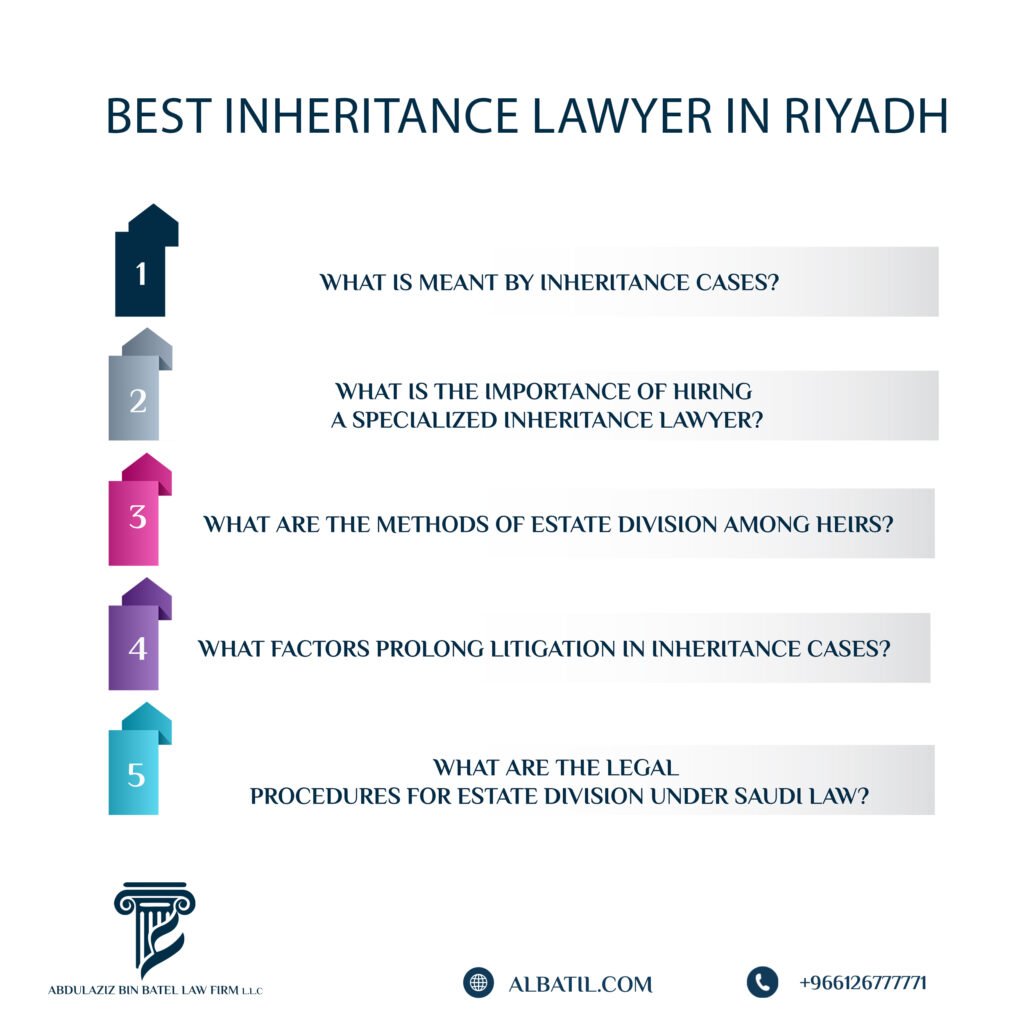
First: What Is Meant by Inheritance Cases?
Inheritance cases refer to legal disputes arising among heirs concerning the distribution of funds, assets, and properties left by a decedent. These matters require a careful study of inheritance laws that intersect with Sharia principles, making them subjects that demand specialized and sensitive handling. The process of estate distribution goes beyond a simple division of assets; it involves a thorough audit of legal instruments, determination of statutory shares, and verification that rights are preserved in compliance with both statutory texts and Sharia jurisprudence.
Inheritance cases are closely linked to family and financial dynamics, as every family member is affected by the probate process. Family ties and emotions often intertwine with legal obligations, necessitating a balanced approach that combines legal precision with human empathy. Understanding heirs’ rights and familiarizing oneself with applicable legal procedures helps prevent potential conflicts and maintains family cohesion and financial stability.
Second: What Is the Importance of Hiring a Specialized Inheritance Lawyer?
In light of the procedural complexities and emotional elements surrounding probate matters, seeking specialized legal counsel is essential to securing one’s full rights. Managing inheritance cases demands utmost accuracy in reviewing documentation and comprehending applicable Sharia principles and statutory frameworks. Consequently, selecting the best inheritance lawyer in Riyadh is a fundamental step for anyone seeking to protect their entitlements and prevent potential disputes.
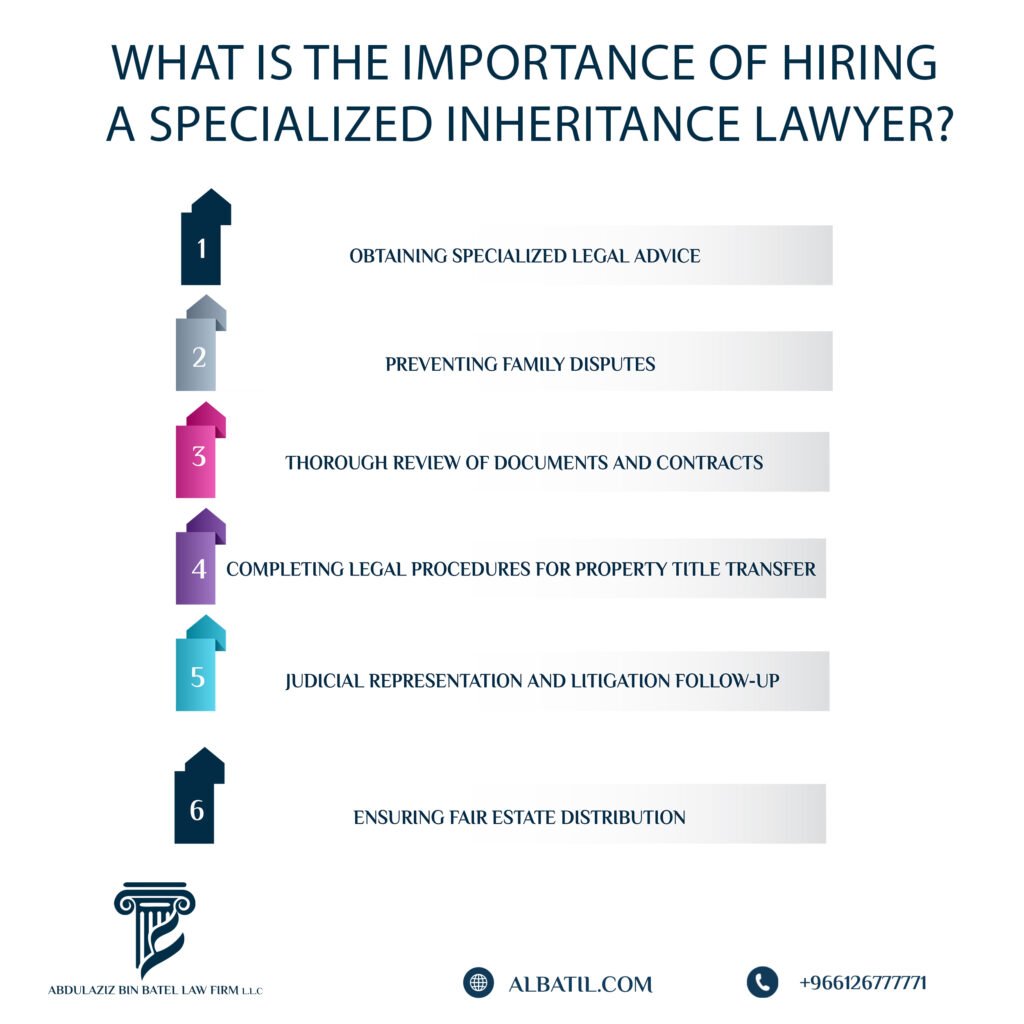
1. Obtaining Specialized Legal Advice
Accurate legal counsel serves as a foundation for understanding the procedures required to claim one’s legitimate share. A specialized attorney provides detailed legal guidance explaining the necessary steps, thereby mitigating legal risks. The best inheritance lawyer in Riyadh applies extensive expertise in service of their clients’ interests.
2. Preventing Family Disputes
Inheritance cases can lead to severe conflicts affecting familial bonds, particularly when distribution terms are unclear. A specialized lawyer clarifies Sharia provisions governing distribution or proposes alternative dispute resolution mechanisms, such as neutral arbitration, to alleviate tension among heirs. In this context, the best inheritance lawyer in Riyadh acts as a bridge for communication and mediation between parties.
3. Thorough Review of Documents and Contracts
Auditing all documents and contracts belonging to the deceased is a vital step in identifying assets and liabilities, thereby establishing the true net share for each heir. A specialized attorney carefully reviews these records to prevent errors in estate accounting, ensuring distribution according to Sharia and legal frameworks under expert oversight.
4. Completing Legal Procedures for Property Title Transfer
Transferring title to real estate and property from the deceased to the heirs involves specific legal procedures compliant with approved regulations. A specialized attorney handles these tasks efficiently, ensuring smooth title transfers without legal complications or delays.
5. Judicial Representation and Litigation Follow-Up
When disputes cannot be resolved amicably, a specialized attorney represents the client before courts and vigorously defends their rights. The attorney tracks judicial proceedings and utilizes available legal avenues to secure a fair outcome, providing reassurance during a challenging period.
6. Ensuring Fair Estate Distribution
Equitable estate distribution is achieved when documentation is audited, heirs are inventoried, Shar’i shares are accurately calculated, and disputes are effectively managed. A specialized attorney offers practical solutions that guarantee transparency and protect the legal rights of every involved party.
Third: What Are the Methods of Estate Division Among Heirs?
Dividing an estate requires precise legal and procedural follow-up to ensure execution in harmony with Islamic Sharia and domestic laws. An inheritance lawyer guides heirs through the necessary steps for a fair division, whether by reaching a consensual agreement or through court proceedings.
Consensual Division (Mutual Agreement)
-
Concept: Consensual division relies on mutual agreement among heirs without judicial intervention. Through dialogue and understanding, heirs agree on a distribution plan that satisfies all parties. This approach is generally smoother, less costly, and saves time while preventing family discord.
-
Role of the Lawyer: The inheritance lawyer acts as a mediator and legal advisor, clarifying statutory provisions and drafting formal agreements that legally bind the mutual understanding. Guided by accurate legal counsel, heirs ensure that the agreement aligns with both Shar’i and statutory standards.
Judicial Division (Compulsory Partition)
-
Nature of Judicial Division: When amicable negotiations fail to yield an agreement, recourse to judicial division becomes necessary. In such cases, the competent court intervenes to divide the estate pursuant to Sharia rulings and Saudi laws. This is known as compulsory partition, where shares are allocated according to statutory order.
-
Judicial Procedure and Representation: The inheritance lawyer represents heirs before the court, submitting required instruments and evidence to prove their entitlements. The attorney monitors judicial proceedings to ensure proper execution under Saudi law.
Fourth: What Factors Prolong Litigation in Inheritance Cases?
Several legal and procedural factors can affect the duration of probate litigation:
-
Complexity and Detail of the Case: Cases involving numerous heirs, business entities, or diversified cross-border assets require extensive document reviews and valuations, which can extend court timelines.
-
Sequential Legal Procedures: Probate involves sequential phases—from proving death and identifying heirs, to asset division and deed transfer. Delays in completing one stage due to administrative hurdles or missing records directly affect the overall duration.
-
Disputes Among Heirs: Disagreements regarding asset valuation or division schemes often necessitate court-ordered appraisals, expert reports, or reconciliation sessions, thereby lengthening proceedings.
-
Incomplete Documentation: Missing title deeds, corporate records, or identification documents create substantial delays while replacement instruments are issued or verified by authorities.
Fifth: What Are the Legal Procedures for Estate Division Under Saudi Law?
Dividing an estate under Saudi regulations requires adherence to structured procedural steps:
1. Settlement of Debts and Financial Liabilities
-
Inventorying Liabilities: Identifying encumbrances, mortgages, and debts attached to the estate, distinguishing between collectable debts and bad debts.
-
Settlement Procedures: Communicating with creditors to settle outstanding liabilities. If liquid assets are insufficient, estate assets may be liquidated under legal supervision to satisfy claims.
2. Inventory and Valuation of Estate Assets
-
Asset Inventory: Cataloging all properties, real estate, companies, bank accounts, stocks, and personal property. Formal inquiries may be submitted to relevant entities (e.g., the Ministry of Commerce or the Capital Market Authority) to confirm asset holdings.
-
Estate Valuation: Appointing accredited appraisers to evaluate estate assets, establishing total valuation as a basis for calculating Shar’i shares.
3. Requesting Determination of Heirs and Deed of Representation
-
Submitting the Petition: Filing the death certificate and official identity documents of all heirs before the competent court to petition for the formal determination instrument.
-
Issuance of the Deed: The court issues the official deed verifying legitimate heirs, ensuring accurate record-keeping and addressing share-related queries.
4. Execution of Wills and Estate Distribution
-
Executing Bequests (Wills): If a valid will exists, the designated bequest is set aside prior to division, provided it does not exceed one-third (1/3) of the net estate (unless approved by all adult heirs).
-
Estate Distribution: Dividing remaining assets among heirs based on calculated Shar’i shares and executing a formal partition agreement confirming voluntary consent.
-
Court Endorsement and Title Transfer: If minor heirs are involved, the division agreement must be endorsed by the Personal Status Court to protect their interests, followed by official title deed transfers at relevant government departments.
5. Legal Documentation
-
Drafting Instruments: Preparing legal contracts confirming final distribution and share allocations.
-
Official Registration: Registering documentation with competent authorities to ensure full legal enforceability.
Conclusion
Inheritance cases demand specialized legal management and diligent procedural tracking. The variety of division methods and the potential complexity of family disputes highlight the importance of retaining a legal expert who can expedite resolution and ensure fair distribution under the law. Partnering with the best inheritance lawyer in Riyadh is a strategic necessity to protect heirs’ interests, manage liabilities, and navigate legal proceedings efficiently.